
- April 8, 2026
- AD Staff Writer
- News
Abilities Expo Brings Resources, Innovation, and Community to Long Beach
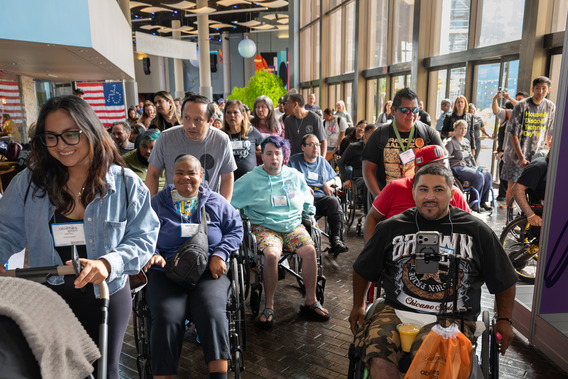
More than 13,000 people visited the Abilities Expo in Long Beach the weekend of March 27–29 to explore the latest products and services for people with disabilities and take part in workshops and adaptive sports, including rock climbing.
Following an opening ceremony featuring State Treasurer Fiona Ma and Long Beach Councilwoman Mary Zendejas, the first Latina wheelchair user elected to public office in the United States, attendees filled the Convention Center to see new technology, goods, and services.
The expo featured more than 200 booths, a showroom of accessible vehicles, adaptive sports equipment, comic books featuring superheroes with disabilities, and a wheelchair repair station. Displays included an exoskeleton that allows people with paraplegia to walk, rugged power wheelchairs for outdoor use, ultralightweight carbon fiber chairs, and foldable power wheelchairs.
For many attendees, the expo offered a chance to explore options that could improve daily life.
Jose Pelayo, a Los Angeles resident attending for the first time, came looking for a better mobility scooter.
“I just wanted to come to see what they had because this one is not good for me,” he said, pointing to his scooter. “I inherited it from my mom, but it’s too heavy. You need two people to lift it into the car.”
Pelayo also hoped to find options that would support his physical activity and help manage chronic pain.
“I’m definitely getting a lot of information here,” he said.
The side-by-side booths hosted by the Aging & Disabilities Department (AD) and the Los Angeles County Commission on Disabilities (LACCOD) drew steady crowds.
“I’m impressed with how professional and knowledgeable the staff are,” said Commissioner Karen Reside of the Los Angeles County Commission for Older Adults (LACCOA), who spent time at the AD booth. “They got information out to a lot of people. A lot of people don’t understand all the services the County offers.”
Visitors asked about services, reporting elder abuse, and how to get involved with County commissions. One attendee received information on how to report suspected elder abuse, including the hotline number and the option to report anonymously.
AD staff also connected with visitors from across Southern California as well as other states, including Louisiana, Pennsylvania, and Tennessee.
At the LACCOD booth, attendees asked about what the commission does, where meetings are held, and how to participate. Some also asked about the 2028 Paralympics in Los Angeles. When questions could not be answered immediately, staff collected contact information for follow-up, said LACCOD President Carlos Benavides.
There was also interest from a Louisiana resident in creating a similar commission in her home state. AD staff promised to follow up with information to support that effort.
“They have my number, so if there’s anything we can help with, we will do that,” Benavides said.
Other highlights included interactive workshops on topics such as disaster preparedness and planning for loved ones with disabilities and special needs. Actress and disability advocate Marissa Bode also participated in a question-and-answer session. Bode, who made her feature film debut as Nessarose in Universal’s Wicked films, was paralyzed at age 11 in a car crash.
The expo also featured adaptive sports, including rock climbing, fencing, dance performances, and wheelchair basketball and football games.
Eddie Sandoval attended with his son Julian, 11, who has Leigh Syndrome, a rare genetic condition that affects motor skills and cognitive abilities. Sandoval cheered Julian on as he climbed the adaptive rock wall.
“He loves this. We come every year,” Sandoval said. “We come to see what new technology is available, and this year we got a lot of information on power wheelchairs.”
While many attendees found valuable resources, some noted gaps.
Viviana Munguia of Silver Lake and Michael Alvarado of Los Angeles, both Marine Corps veterans, had hoped to find devices for those with limited vision and information on VA benefits for spouses. Munguia, who has a visual field condition, said she did not find the resources she was looking for.
She also described challenges navigating her neighborhood due to overgrown sidewalks.
“I’m trying to stay active, but I have to walk in the middle of the street because there’s grass and brush that’s so overgrown onto the sidewalk that I can’t get through,” Munguia said.
Alvarado shared similar frustrations with accessing information.
“When calling the VA 800 line, I’ve been put on hold for hours,” he said.
LACCOD Commissioner Héctor M. Ramírez drew attention by wearing his California State University, Northridge alumni sweatshirt and fist-bumping fellow CSUN graduates.
Among those he connected with was Elena Tiffany, a Reseda resident with Tuberous Sclerosis Complex, who said she is seeking a job after years of advocacy work.
“I’ve been doing a ton of advocacy work for the IDD community, but I’m hoping to get a job, not just volunteer work,” Tiffany said. “I’ve noticed when you ask for an accommodation during the application process, you get ghosted.”
LACCOD and the Aging & Disabilities Department are part of an effort led by the Department of Human Resources (DHR) to develop a County pilot program aimed at increasing employment opportunities for members of the neurodivergent community.